
A finished basement can be one of the most useful spaces in a home. It might provide a second family room, a home office, a workout area, or room for guests.
So why might a home with 1,800 square feet upstairs and another 900 finished square feet downstairs still appear as an 1,800-square-foot home on an appraisal?
The answer comes down to what the number measures.
Finished basement space is generally reported separately from above-grade finished square footage in appraisals that follow ANSI measurement standards. That does not mean the basement has no value.
For buyers and sellers, understanding that distinction helps prevent confusion about listings, pricing, and appraisals.
Above Grade vs. Below Grade
“Grade” refers to the ground level around the home.
Under Fannie Mae’s appraisal guidance, a level is considered below grade if any portion of it is below ground. The quality of the finishes and the amount of window space do not change that classification.
That means a partially below-ground level can be reported separately even if it feels bright, comfortable, and fully integrated with the rest of the house.
This article focuses on single-family homes. Condominiums in apartment-style buildings and multifamily properties can involve different measurement methods.
What About a Walkout Basement?
A walkout basement can feel very different from a traditional basement. It may have full-size windows, an exterior door, and direct access to a patio or backyard.
But a walkout does not automatically become above-grade space.
If part of that level is below ground, Fannie Mae’s guidance treats it as below grade, with its area reported separately from the above-grade finished area.
For a buyer, the useful questions go beyond the label: How much natural light does the space receive? How does it connect to the yard? Is it comfortable year-round? Does the layout work for how you plan to use it?
Reported Separately Doesn’t Mean Worthless
A finished basement may add substantial value even though it is excluded from the above-grade square footage. Fannie Mae specifically recognizes that below-grade finished rooms can contribute meaningfully to a property’s value.
The practical takeaway is that measurement and market value answer different questions.
Measurement tells you how much space exists and how it is classified. Market analysis considers how buyers respond to that space compared with other available and recently sold homes.
A useful basement comparison should look beyond the square footage. Consider the layout, finish quality, natural light, ceiling height, bathrooms, access, and overall condition.
Avoid assuming that every dollar spent finishing a basement will return at resale. Also avoid assuming that each basement square foot should be valued the same as a square foot upstairs. Your broker can help you examine comparable sales rather than apply a blanket formula.
Why Listing Numbers Need a Closer Look
When you see a square-footage figure online, ask what it includes.
Is it above-grade finished area? Does it combine upstairs space with finished basement space? Is the source a measurement, a previous listing, public records, or an owner’s estimate?
A number without that context can make two different homes appear directly comparable.
For example:
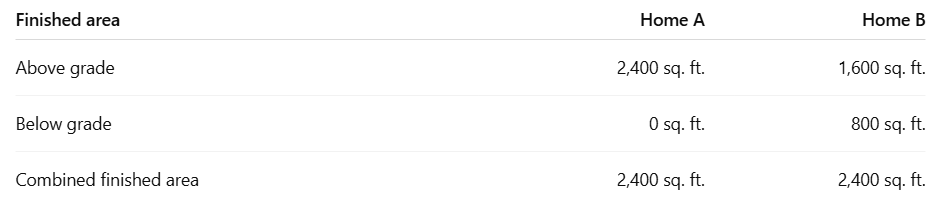
Both homes have 2,400 square feet of combined finished area in this example. But the space is distributed differently.
One might offer more bedrooms and larger rooms upstairs. The other might provide a separate recreation area downstairs. Neither arrangement automatically makes one home better, but the distinction matters when comparing layout, price, and comparable sales.
Be Careful With Price Per Square Foot
Price per square foot is only useful when the underlying measurements are comparable.
Consider a hypothetical home priced at $450,000 with:
1,800 square feet above grade
900 square feet of finished basement space
Dividing the price by the above-grade area produces $250 per square foot. Dividing it by the combined finished area produces approximately $167 per square foot.
The home and asking price haven’t changed. Only the denominator has changed.
Before concluding that one property is a bargain, or overpriced, confirm that you are comparing square footage on the same basis. Then consider condition, location, layout, lot, and other features.
Does a Basement Bedroom Count?
A room’s use, its compliance with local requirements, and its treatment on an appraisal are separate questions.
Putting a bed in a finished room does not establish that it meets the requirements for a bedroom. Before relying on a basement room as sleeping space, verify applicable requirements with the local building department. Those may involve emergency escape and rescue openings, ceiling height, ventilation, and other safety provisions.
Also clarify where the advertised bedrooms are located. A home with three bedrooms upstairs and one downstairs may function differently for your household than a home with all four bedrooms on the same level.
A floor plan and an in-person walkthrough can make that distinction much clearer than a bedroom count alone.
What Sellers Should Do
If you’re preparing to sell a home with a finished basement, make it easy for buyers to understand the space.
Work with your broker to:
Identify the source of the square-footage figures.
Clearly distinguish above-grade and below-grade finished areas.
Describe the basement’s layout and features accurately.
Gather available permits and renovation records.
Use photographs and floor plans to show how the space functions.
You can highlight a great basement without creating the impression that all finished space belongs in the same measurement category.
Clear information helps buyers understand what they are purchasing and reduces surprises when the appraisal arrives.
What Buyers Should Ask
Before relying on a listing’s square footage, ask:
Does this figure include the basement?
How much finished space is above grade?
What is the source of the measurements?
Where are the bedrooms and bathrooms located?
Are permits or other records available for the basement work?
Will the layout support how I want to use the home?
If a minimum amount of space is essential to your decision, discuss verification with your broker early in the process.
Look Beyond the Headline Number
A finished basement can make a home more comfortable, more functional, and more appealing. Its separate treatment on an appraisal doesn’t erase those benefits.
The important thing is to understand what the square-footage figure includes, compare homes consistently, and evaluate how the entire property fits your needs.
At AED Realty, we help buyers and sellers make sense of the details behind the listing—from how space is reported to how it fits into the broader pricing picture.
Planning your next move? Explore our buyer resources or seller resources to get started.
Clarity. Strategy. Execution.
Disclaimer: This article provides general educational information and is not legal, appraisal, lending, or construction advice. Measurement standards, lender requirements, MLS reporting practices, and local building requirements may differ. Verify property-specific information with the appropriate professionals. Square-footage and pricing examples are illustrative.