
You’re thinking about selling, and suddenly every room comes with a question.
Should you replace the kitchen countertops? Update the bathrooms? Pull out the carpet? Finish the basement?
It’s easy to start building a renovation list before you’ve decided what the home actually needs to compete.
Some improvements can help you sell. Others can consume your time and money without producing a better financial result.
Before hiring a contractor, start with your home’s condition, the local competition, and your goals for the sale.
Start With the Market, Not the Project List
The right preparation plan depends on what buyers can purchase instead of your home.
Look at comparable properties that recently sold, homes currently competing for buyers, and listings that have struggled to attract an offer. Compare their condition, finishes, location, layout, and price.
If competing homes offer updated kitchens, that deserves consideration. But it doesn’t automatically mean you should install a new kitchen. Pricing your home to reflect its condition may be a practical alternative.
Your broker can help you evaluate whether a project is likely to improve your position enough to justify its cost and the delay.
Separate Repairs From Cosmetic Updates
A dated bathroom and an active plumbing leak call for different decisions.
Before choosing paint colors or cabinet hardware, identify maintenance, safety, and functional concerns. A roof leak, malfunctioning equipment, or moisture problem deserves professional evaluation so you understand the scope and your options.
Cosmetic decisions can then be considered separately.
A useful starting point is to organize potential work into three groups:
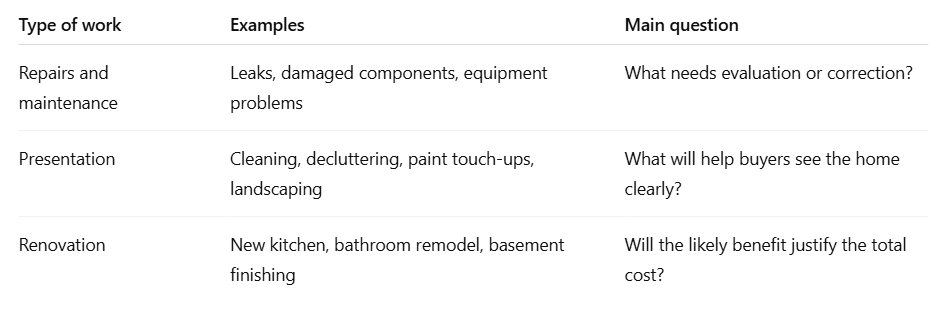
This helps keep an expensive wish list from taking priority over more immediate concerns.
Consider Preparation Before Major Renovation
Start by assessing what you can accomplish with focused preparation.
Depending on the property, that might include deep cleaning, removing excess furniture, addressing odors, touching up worn paint, cleaning flooring, or tidying the entrance and landscaping.
These steps can make the home easier to photograph and show without committing you to a major construction project.
The goal is to present the property at its best while keeping the work appropriate for its condition and price range.
For example, a kitchen with functional cabinets and an older appearance may benefit from cleaning, minor repairs, and better presentation. Replacing everything deserves a separate financial analysis.
A Higher Sale Price Doesn’t Necessarily Mean More Money
A renovation can increase the sale price and still leave you with less money.
Consider this hypothetical comparison:
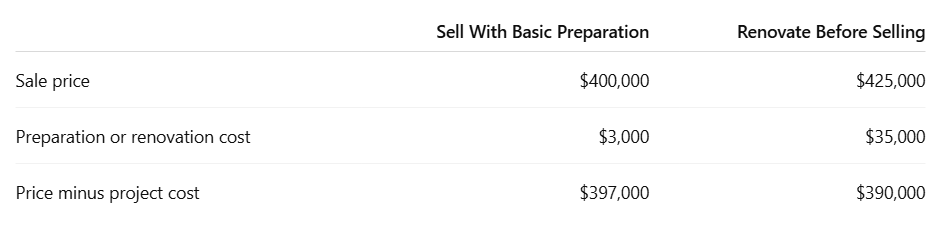
The renovated home sells for $25,000 more, but the additional work costs $32,000 more. Before other selling expenses, the seller is $7,000 behind.
These figures are illustrative, not a prediction. They exclude mortgage payoff, commissions, taxes, closing costs, and additional carrying expenses.
The point is to compare the expected financial result, not just the possible sale price.
National remodeling research also distinguishes project cost from estimated resale recovery. The National Association of REALTORS® and National Association of the Remodeling Industry’s 2025 Remodeling Impact Report found that many evaluated projects were estimated to recover less than their full cost at resale. Those estimates provide context, not a property-specific guarantee.
Include the Cost of Waiting
The contractor’s proposal is only part of the budget.
If the work delays your sale, consider additional mortgage interest, property taxes, insurance, utilities, maintenance, and any financing costs for the project.
Also account for uncertainty. Materials can arrive late. Contractors can uncover additional work. A project that starts as a small update can expand once demolition begins.
Ask yourself:
How soon do I need to move?
Can I comfortably fund the work?
What happens if the project runs over budget?
Is the expected benefit worth delaying the listing?
Your timeline may make basic preparation and a well-supported price more attractive than a larger renovation.
Avoid Renovating Beyond the Likely Buyer’s Expectations
A premium finish can be beautiful without being a sensible investment immediately before selling.
Before choosing materials, review the level of finish buyers are responding to in comparable homes. Highly customized features may appeal to you but have a narrower audience.
The same applies to an expensive renovation in an otherwise dated home. Updating one room does not necessarily place the entire property in the same competitive position as a fully renovated house.
Evaluate the home as a whole and keep the scope consistent with the likely market.
When Renovating May Make Sense
A project may be worth considering when there is a specific problem to solve and a credible financial case for solving it.
For example:
A focused repair could address a concern likely to dominate buyer feedback.
A limited update could improve an otherwise well-maintained home’s presentation.
A clearly defined project could help the property compete with comparable homes.
You have reliable estimates, sufficient time, and room in the budget for surprises.
Get written proposals and confirm applicable permit and association requirements before committing.
Compare a realistic range of outcomes. A plan that only works if the project stays perfectly on budget and the home achieves the highest possible price deserves another look.
When Selling in the Current Condition May Make Sense
Selling without major renovations can be a reasonable choice when the work is extensive, funds are limited, timing matters, or buyers are likely to make their own changes.
That approach still benefits from preparation, accurate information, and pricing that reflects the property’s condition.
If you are considering an “as-is” sale, have your broker and attorney explain the contract terms and applicable disclosure obligations. Don’t assume that label resolves every repair, inspection, or disclosure question.
Build the Plan Before Spending the Money
Before starting work, walk through the property with your broker and discuss:
Which concerns need professional evaluation.
Which preparation steps deserve priority.
Which projects need estimates before making a decision.
How the home could be positioned with and without renovations.
That conversation can help you direct your budget toward work with a clear purpose.
At AED Realty, we help sellers evaluate preparation, pricing, and timing together so they can make informed decisions before committing to improvements.
Thinking about selling? Visit AEDRealty.com/sell to start building a plan for your home.
Clarity. Strategy. Execution.
Disclaimer: This article provides general educational information and is not legal, tax, financial, or construction advice. Project costs, market conditions, permit requirements, and individual circumstances vary. Consult appropriate professionals before making renovation or sale decisions. Examples are illustrative, and no sale price, cost recovery, or timeline is guaranteed.