
You’ve found a condo that fits your needs, and the monthly association fee seems manageable. Then you learn the building needs a new roof—and owners may receive an additional bill.
That’s where a special assessment comes into the picture.
Before buying a condo, look beyond the monthly dues. Understanding the association’s planned projects, reserves, and special assessments can help you evaluate the true cost of ownership.
What Is a Special Assessment?
A special assessment is an additional charge imposed by the condominium association outside its regular assessments. It may help fund a major repair, an unexpected expense, or another association obligation.
Examples could include roof replacement, masonry repairs, elevator work, or repairs to shared plumbing.
The approval process depends on the purpose of the assessment and applicable requirements. Don’t assume every special assessment requires a vote of all owners. Illinois guidance explains that boards can adopt many special assessments without a unit-owner vote, subject to statutory procedures and exceptions. idfpr.illinois.gov
How Much Could Your Share Be?
Don’t assume the total project cost will be divided equally among the units.
Under the Illinois Condominium Property Act, common expenses generally follow each unit’s ownership percentage stated in the declaration, with certain exceptions. As Effective January 1, 2025
For example:
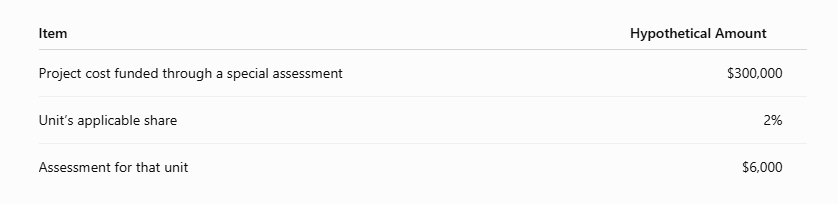
Illustrative example only. Actual charges depend on the assessment, governing documents, and applicable law.
Ask for the amount assigned to the specific unit and the payment schedule. A lump-sum payment and an installment plan can have very different effects on your cash needs.
Does a Special Assessment Mean the Building Is Poorly Managed?
Not automatically.
A special assessment may fund necessary work that helps preserve the building. The more useful questions are why the expense arose, how the association planned for it, and whether the proposed funding addresses the need.
Consider:
Was the work anticipated or unexpected?
Why aren’t existing reserves covering the full cost?
Is the project scope supported by professional evaluations?
Are other major projects approaching?
Has the association relied on repeated special assessments?
A well-explained assessment for a defined project deserves a different evaluation from recurring charges with unclear plans.
Low Monthly Dues Aren’t the Whole Story
Low association dues can be attractive, but they should be considered alongside what the association maintains and how it funds future work.
Ask how much of the budget supports ongoing operations and how much goes toward reserves. Review any available reserve study, its date, and how the association is using it.
Illinois law identifies repair and replacement costs, estimated useful life, and any professional reserve study among the factors boards should consider when determining appropriate reserves. ilga.gov
There is no single reserve balance that tells you everything. The money available needs to be evaluated against the building’s condition and expected obligations.
What Should Buyers Review?
Ask your broker and attorney to help obtain and review relevant association information, including:
The current budget and available financial statements.
Reserve balances and any available reserve study.
Approved special assessments and the unit’s remaining balance.
Meeting minutes discussing repairs, funding, or proposed assessments.
Available engineering reports and project estimates.
The declaration, bylaws, and applicable rules.
For Illinois condo resales, Section 22.1 provides for specified information to be made available upon demand, including unpaid assessments, anticipated capital expenditures, reserve information, and financial information. Your attorney can explain the requirements that apply to your transaction. ilga.gov
Ask About Work That Hasn’t Been Approved Yet
“ No special assessment currently approved” answers only one question.
A building may already be discussing a major repair without having approved its scope, cost, or funding.
Ask:
What major work is being considered?
Have contractors or engineers evaluated it?
Are estimates available?
How does the association expect to pay for it?
When are further decisions expected?
The goal is to understand known concerns and plans, while recognizing that future costs cannot always be predicted.
Who Pays If the Condo Is Being Sold?
Don’t assume the seller pays every assessment approved before closing—or that an installment due after closing automatically belongs to the buyer.
Have your attorney review the contract, assessment documents, payment schedule, and association requirements to establish responsibility.
If the seller agrees to pay an assessment, make sure that agreement is documented and coordinated with the closing team. Also clarify whether the arrangement covers the full remaining balance or only particular installments.
What If You Already Own the Condo?
Read the notice carefully and request the details behind the charge.
Confirm the purpose, your unit’s amount, payment deadlines, and any available payment arrangements. Review the supporting project information and attend association meetings when possible.
If you have questions about how an assessment was adopted or your rights as an owner, consult an Illinois attorney promptly. Procedures for challenging certain assessments can involve short deadlines. idfpr.illinois.gov
Evaluate the Building Along With the Unit
A condo purchase includes financial responsibilities connected to the shared property.
A special assessment doesn’t automatically make a condo the wrong purchase. It does mean you should understand the expense, the work it funds, and how it fits your budget before moving forward.
At AED Realty, we help buyers look beyond the unit’s finishes and coordinate the questions that matter about the association and ownership costs.
Considering a condo? Contact AED Realty to build a search around both the home and the responsibilities that come with it.
This article is for general informational purposes only and is not a substitute for legal, financial, mortgage, insurance, engineering, or other professional advice. Assessment obligations, approval procedures, document requirements, and buyer and seller responsibilities depend on applicable law, governing documents, contract terms, and individual circumstances. Consult your real estate attorney and other qualified professionals regarding your specific property or transaction.