
One home has the updated kitchen, finished bathrooms, and flooring you would have chosen yourself. Another costs less but needs some attention.
Which is the better purchase?
The answer depends on the total cost, the work involved, and how each home fits your life. A finished home may justify a higher price through convenience. A home that needs work may offer flexibility—but only if the project makes sense financially and practically.
What Are You Getting for the Higher Price?
An updated home can be appealing because you can move in and start enjoying it without immediately managing a renovation.
That convenience may be especially valuable if you have a demanding schedule, limited cash available after closing, or little interest in coordinating contractors.
Still, look beyond the finishes. New cabinets and countertops don’t establish the condition of the roof, foundation, electrical system, or plumbing.
Ask what was updated, when the work was completed, and what documentation is available. A home that looks finished still deserves a professional inspection.
“Needs Work” Can Mean Very Different Things
There is a significant difference between a home that needs paint and one that needs structural repairs.
Before comparing prices, separate the work into three categories:
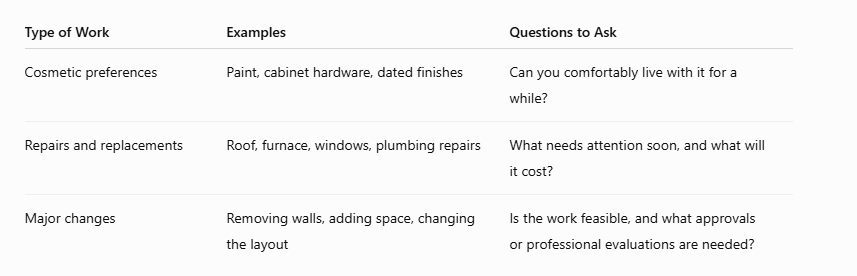
A dated bathroom may be perfectly usable. An active leak needs a different level of attention.
Have qualified professionals evaluate concerns rather than assuming every project is straightforward. Freddie Mac emphasizes inspections and planning for unexpected repairs when considering properties that need substantial work. My Home by Freddie Mac
Compare the Total Investment
A lower purchase price is only the starting point.
For a home that needs work, consider:
The purchase price and closing costs.
Contractor labor and materials.
Design, engineering, and permits where needed.
A reserve for unexpected conditions.
Temporary housing, storage, or overlapping housing expenses.
Financing costs associated with the project.
For example, a $350,000 home with $60,000 in planned work represents a $410,000 purchase-and-renovation subtotal—before closing costs, unexpected repairs, or other project expenses.
That doesn’t automatically make a $410,000 updated home the better choice. It gives you a more useful basis for comparison.
Spending $60,000 on improvements also does not guarantee the home will be worth $60,000 more. Review the likely finished result against comparable properties before assuming the project will create equity.
Monthly Affordability and Available Cash Are Different Questions
An updated home may mean a larger mortgage payment. A less expensive home may leave you with a smaller payment but require substantial cash for improvements.
Ask yourself:
How much money would remain after closing?
Which repairs would need to happen immediately?
Could you fund the work without exhausting your emergency savings?
Would financing the improvements change the overall cost?
The CFPB recommends setting aside money for renovations, moving, furnishings, and an emergency cushion when deciding how much cash to use toward a purchase. Consumer Financial Protection Bureau
Some loan products can combine eligible purchase and renovation costs, but requirements vary. Discuss the property’s condition and your plans with your lender early. My Home by Freddie Mac
Be Realistic About Your Time
A renovation requires decisions as well as money.
Someone needs to obtain estimates, select materials, coordinate access, respond to questions, and handle changes. Even when a contractor manages the project, you still have responsibilities.
If your plan depends on doing the work yourself, consider your experience, tools, available hours, and which tasks require professional help.
Ask a practical question: Would you still want this home if the work took longer than expected?
Living with an unfinished kitchen or ongoing construction can feel different after several months than it did during a showing.
Prioritize What Is Difficult to Change
Look closely at the location, lot, layout, parking, and usable space before focusing on finishes.
An attractive kitchen may not overcome a layout that doesn’t work for your household. Similarly, a dated home may be worth considering if its existing space and location meet your needs.
Avoid assuming you can fix every limitation later. An addition, relocated bathroom, or removed wall may require more money and investigation than expected.
If a proposed change is essential to your decision, investigate its feasibility before relying on it.
Get Estimates Before Committing to a Project
When possible within your transaction’s access permissions and deadlines, obtain written estimates for significant work.
Ask contractors to explain what is included, what is excluded, and which conditions could change the price. Compare the scope of the proposals rather than just the totals.
Freddie Mac recommends checking references from similar projects and considering a contractor’s reliability and work quality alongside price. My Home by Freddie Mac
A rough guess during a showing is useful for identifying questions. It should not become the foundation of your renovation budget.
Which Home Is the Better Fit?
An updated home may make sense when you value convenience, want fewer immediate projects, and can comfortably support the total ownership cost.
A home that needs work may make sense when the location and existing layout fit, the project has been evaluated, and you have the money, time, and flexibility to carry it through.
Neither choice guarantees a better financial outcome. The goal is to understand what you are buying and what ownership will require after closing.
At AED Realty, we help buyers look beyond listing photos and compare condition, potential improvements, ownership costs, and everyday practicality.
Deciding between an updated home and one with potential? Contact AED Realty to build a search around your priorities and comfort level.
This article is for general informational purposes only and is not a substitute for financial, mortgage, legal, tax, inspection, engineering, or construction advice. Property conditions, renovation costs, financing eligibility, permit requirements, and individual circumstances vary. Consult qualified professionals before purchasing a property or committing to improvements. Renovations do not guarantee an increase in market value or a return on investment.