
What Happens When the Appraisal Comes in Low?
You’ve agreed on a price, completed inspections, and started planning your move. Then your lender calls: the appraisal came in below the purchase price.
Does that mean the deal is over?
Not necessarily. A low appraisal creates a financing issue to work through, but the available options depend on your loan, your contract, and what the buyer and seller are willing to agree to.
What Does a Low Appraisal Mean?
An appraisal is a professional opinion of the property’s value. When the appraised value is lower than the agreed purchase price, the lender may reduce the loan amount or require changes before approving the financing. Fannie Mae
For example, if you agree to purchase a home for $400,000 and it appraises for $380,000, there is a $20,000 difference between the contract price and appraised value.
That difference is often called an appraisal gap. However, it does not automatically mean you need exactly $20,000 more in cash. Your lender needs to calculate how the lower value affects your specific financing.
Start With the Report and the Numbers
Before deciding what to do, get a copy of the appraisal and review it with your lender and broker.
Ask your lender:
Can the loan still proceed under the current structure?
Would the maximum loan amount change?
How much cash would you need at closing?
Would mortgage insurance, pricing, or other loan terms change?
What deadlines could be affected?
Your broker can help review the property information and comparable sales. Your attorney should review the contract provisions and deadlines that apply to your options.
Option 1: Negotiate a Lower Purchase Price
The buyer can ask the seller to reduce the price based on the appraisal. The seller may agree, decline, or propose a smaller reduction. A low appraisal does not automatically change the contract price. Consumer Financial Protection Bureau
The conversation should consider the appraisal findings, available market evidence, and each party’s circumstances.
For sellers, this is a reason to evaluate financing and appraisal terms when reviewing offers. The highest offered price may come with uncertainty about how the buyer would handle a shortfall.
Option 2: Contribute Additional Cash
A buyer may be able to proceed at the agreed price by contributing more cash, subject to lender approval.
Consider this simplified example:
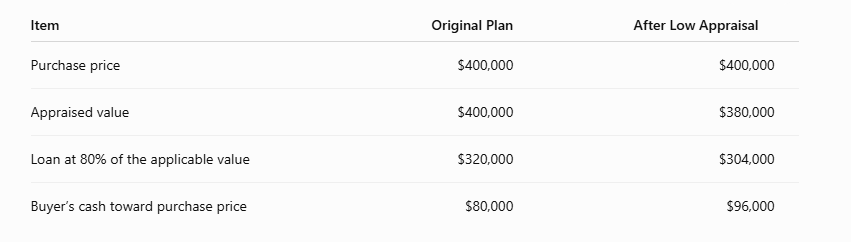
Illustrative example only. Assumes the lender limits the loan to 80% of the lower of the purchase price or appraised value. Excludes closing costs, prepaid expenses, and other adjustments. Actual loan requirements vary.
In this example, the buyer needs $16,000 more toward the purchase price, even though the appraisal gap is $20,000.
Before committing additional funds, consider what would remain for emergencies, repairs, and other financial goals. Ask your lender to explain any alternative financing structures and their costs.
Option 3: Combine a Price Reduction With Additional Cash
The buyer and seller may agree to share the difference through a lower purchase price and an increased buyer contribution.
There is no automatic requirement to split the gap equally. Any agreement needs to work with the buyer’s financing and be properly documented.
Before accepting revised terms, have the lender confirm the updated cash needed to close.
Option 4: Request a Reconsideration of Value
If the report appears to contain errors or omit relevant information, ask your lender about its reconsideration of value, or ROV, process.
Potential issues to identify include:
Incorrect property characteristics.
Relevant features that were overlooked.
Additional appropriate comparable sales.
Analysis that needs clarification or support.
An ROV should present specific evidence. Disagreeing with the number alone does not establish that the appraisal is inaccurate, and a review does not guarantee a higher value. Appraisal questions and supporting information should go through the lender. MyCreditUnion.gov
Option 5: Consider Ending the Transaction
If an agreement cannot be reached, termination may be an option—but do not assume a low appraisal automatically allows you to cancel and recover your earnest money.
Your rights depend on the contract, including any appraisal or financing contingencies, appraisal-gap commitments, notice requirements, and deadlines. Have your attorney explain those provisions before you act. Depending on the agreement, cancelling could put your deposit at risk. Fannie Mae
What If You Agreed to Cover an Appraisal Gap?
Review the exact language with your attorney and lender.
A commitment to contribute up to a stated amount may have different consequences from a broader waiver of appraisal protections. You need to understand:
How much additional cash you committed to provide.
What happens if the shortfall exceeds that amount.
Whether the lender can still approve the loan.
Which contractual protections remain available.
These questions are best addressed before making the offer, while you can decide how much uncertainty you are comfortable accepting.
Make the Decision With the Full Picture
A low appraisal deserves a careful review of the value evidence, financing, contract, and your financial comfort.
You may be able to negotiate, adjust the financing, provide additional cash, or identify information that warrants further review. In other circumstances, continuing may no longer make sense.
At AED Realty, we help buyers and sellers evaluate the options and coordinate with their lender and attorney so they can make an informed decision.
Have questions about appraisal terms before making or accepting an offer? Contact AED Realty to discuss how they fit into your transaction strategy.
This article is for general informational purposes only and is not a substitute for mortgage, financial, appraisal, legal, tax, or other professional advice. Loan requirements, contract terms, deadlines, and individual circumstances vary. Consult your lender, real estate attorney, and other qualified professionals regarding your specific transaction.