
You’ve talked to a lender, provided your financial information, and received a preapproval. Now you have a number to guide your home search.
But should that number become your budget?
What a lender is willing to lend you and what you feel comfortable spending can be different amounts. Understanding that difference can help you buy a home while leaving room for the rest of your life.
What Does It Mean to Qualify for a Mortgage?
Lenders evaluate your financial information against their lending requirements. That review generally includes your income, debts, credit history, and available funds.
One measure is your debt-to-income ratio, which compares your monthly debt payments with your gross monthly income—your income before taxes and other deductions. Limits vary by lender and loan program. My Home by Freddie Mac
That evaluation helps determine whether you qualify for financing. Your household budget answers another question: how much can you spend while continuing to meet your other needs and goals?
Start With Your Take-Home Pay
Your mortgage payment comes out of the money you actually receive.
Review your take-home pay alongside your regular spending, including:
Groceries, transportation, and utilities.
Childcare, education, and family responsibilities.
Medical expenses and insurance.
Retirement contributions and other savings.
Travel, hobbies, and entertainment.
Expenses that occur seasonally or annually.
Use several months of actual spending rather than an idealized budget. The CFPB recommends accounting for less frequent expenses and comparing your spending with your take-home income. Consumer Financial Protection Bureau
If the numbers only work after assuming you’ll sharply reduce spending, consider how realistic those changes would be.
Look Beyond Principal and Interest
An online calculator’s payment estimate may not include everything you’ll need to budget for.
Review:
Mortgage principal and interest.
Property taxes.
Homeowners insurance.
Mortgage insurance, when applicable.
Association dues, when applicable.
Additional insurance required for the property.
Then account separately for utilities, maintenance, and repairs. Some expenses may be collected through your mortgage payment; others will be paid directly. Either way, they affect your budget. Consumer Financial Protection Bureau
Ask your lender for a property-specific estimate and confirm what is included.
Two Similarly Priced Homes Can Have Different Monthly Costs
Purchase price alone doesn’t tell you what a home will cost to own.
Consider this hypothetical comparison:
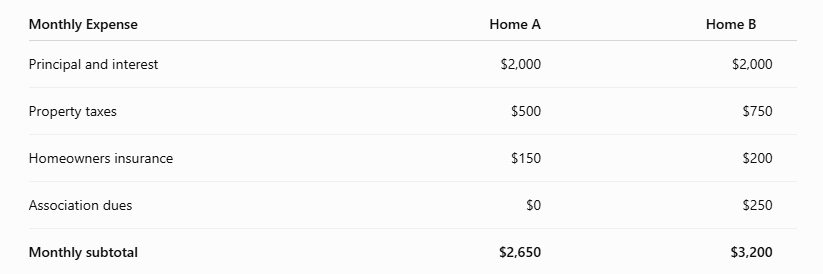
Illustrative figures only. These are not loan quotes and exclude utilities, maintenance, repairs, and any applicable mortgage insurance.
That’s a $550 monthly difference, even with the same principal and interest payment.
As you compare properties, ask for updated estimates rather than assuming every home in your price range fits the same budget.
Leave Money Available After Closing
Your down payment and closing costs are only part of your cash planning.
You may also need money for moving, immediate repairs, furnishings, and unexpected expenses. Consider how much savings would remain after the purchase—and whether you would feel comfortable with that cushion.
A larger down payment can reduce borrowing, but putting more cash into the purchase also leaves less available for other needs. Review both the payment and your remaining reserves with your lender.
Think About What Could Change
A payment that works today should also be considered alongside foreseeable changes.
Ask yourself:
Would the payment still work without overtime, bonuses, or commissions?
Are childcare, education, or transportation costs likely to change?
Are you planning a career change or approaching retirement?
Could you handle an increase in taxes, insurance, or association dues?
Would you still be able to save each month?
Even with a fixed-rate mortgage, the total cost of ownership can change. Property taxes and insurance, for example, may increase over time. Consumer Financial Protection Bureau
Give Your Lender and Broker a Comfortable Payment Target
Instead of starting with, “What is the most expensive home I can buy?” try:
“I want to keep my total monthly housing payment around this amount. What purchase range could support that?”
Tell your lender which costs you want included in that target. Also clarify how much you plan to reserve separately for maintenance and utilities.
Your lender can help translate the payment target into financing scenarios. Your broker can help you compare properties with attention to taxes, association dues, condition, and other ownership considerations.
Choose a Budget That Fits Your Life
A preapproval is useful information. It doesn’t have to become your spending goal.
The right budget should support both the home you want and the life you want to maintain after moving in. The CFPB encourages buyers to focus on what fits their priorities rather than simply borrowing the maximum available. Consumer Financial Protection Bureau
At AED Realty, we help buyers connect their home search with their priorities, ownership costs, and financing conversations.
Planning to buy? Contact AED Realty to build a search around a budget that works for you.
This article is for general informational purposes only and is not a substitute for financial, mortgage, tax, legal, or other professional advice. Loan qualification, financing terms, property expenses, and individual circumstances vary. Consult a qualified lender and appropriate financial or tax professionals when evaluating your homebuying budget.